


By Ryan Forrest, RevOps and sales
Short answer: Sales and marketing drift apart when they chase different goals, use different words for a "good lead," and pass leads with no rules. You fix it with one shared lead definition, a clear handoff with a time limit, and a way for sales to tell marketing what happened.
I have seen this in a lot of teams. Marketing says, "We sent you 200 leads." Sales says, "They were all junk." Both sides are a little bit right, but the real problem sits in the middle, at the handoff.
The good news is that you can fix most of it inside the CRM you already use. Here is how I would do it.
What does it mean when sales and marketing are "misaligned"?
It means the two teams are not working toward the same result, even when they sit next to each other.
Marketing gets credit for leads, while sales gets paid for closed deals. So marketing pushes for more leads, and sales wants fewer, better ones. Nobody is doing a bad job. They are just keeping score in two different games.
You can spot it fast. Look for these signs:
- Sales does not call new leads for days.
- Marketing has no idea which leads turned into deals.
- Each team shows a different number in the Monday meeting.
- People fight about lead quality, but nobody can say what "quality" means.
Why do sales and marketing stop lining up?
It almost always comes down to five gaps.
- Different goals. Marketing counts leads. Sales counts revenue. If the goals don't connect, the teams won't either.
- No shared word for a good lead. One team calls a lead "hot" after a download. The other team wants a budget and a real need.
- No handoff rules. A lead lands in the CRM and just sits there. Nobody owns it, and nobody has a deadline.
- Messy data. Fields are blank. The lead source is missing. Nobody trusts the reports.
- No feedback. Sales loses a deal, but never tells marketing why. So marketing keeps sending the same kind of lead.
Fix these five gaps, and most of the fighting between the teams stops on its own.
How do you agree on what a good lead is?
Sit both teams down for one hour and write the answer on a single page.
Keep it simple. For example, a sales-ready lead might need these three things:
- It fits the type of company you sell to.
- The person has a real problem you can solve.
- They asked for a next step, like a demo or a call.
Then give each step a name both teams use. In HubSpot, this is the Lifecycle stage field. A common path is Lead, then Marketing Qualified Lead, then Sales Qualified Lead, then Opportunity, then Customer.
Here is the key part: write down exactly what moves a lead from one stage to the next. If you can't say the rule in one plain sentence, it is not clear enough yet.
How do you set up a lead handoff in your CRM?
Every good handoff needs three things: an owner, a deadline, and a reminder when someone forgets.
Here is a simple way to do it in HubSpot:
- Pick the trigger. Choose the moment a lead is ready for sales. For many teams, that is when the Lifecycle stage turns into Marketing Qualified Lead.
- Assign an owner right away. Build a workflow that rotates the lead to a rep. No lead should sit with no owner.
- Create a task with a due date. Have the same workflow make a "Call this lead" task. Set it due in one business day.
- Use Lead Status. Ask reps to update the Lead status field, like New, Attempting to contact, Connected, or Bad timing. Now marketing can see what is going on.
- Add a safety net. If the lead is still "New" after two days, send a note to the sales manager.
This is your service level agreement, or SLA, which is just a fancy name for a promise. Marketing promises good leads, and sales promises fast follow-up. The workflow keeps both sides honest.
How does sales send feedback back to marketing?
Make it part of closing a deal. When a rep marks a deal Closed Lost, ask them one quick question: why did we lose it? Use a dropdown, not a blank text box. Dropdowns give you clean data that you can count and sort later. Good choices are things like "No budget," "Went with a rival," "Bad fit," and "No decision."
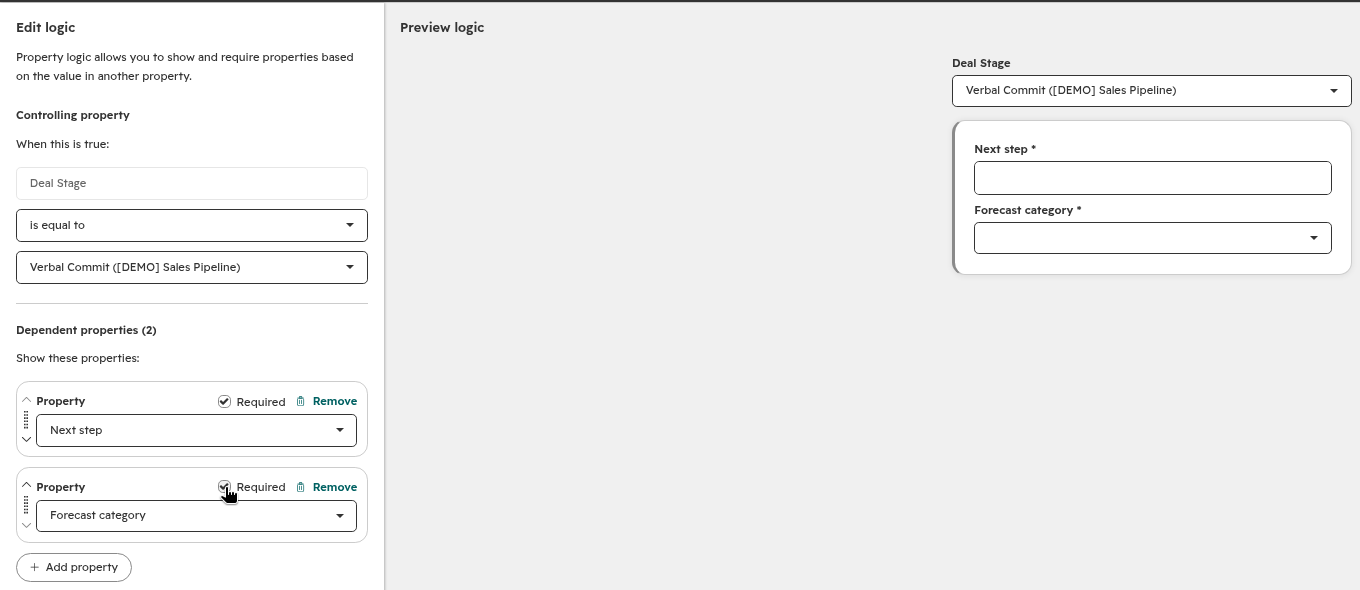
In HubSpot, you can make a field required when a deal hits a certain stage. You set this up in your pipeline settings with conditional logic rules. Here is what that looks like on a demo pipeline. When the deal moves to a stage, the rep has to fill in the fields before they can save.
Demo data. The same setting works for a "Closed lost reason" field on your Closed Lost stage.
Then, once a month, pull a simple report that shows closed-lost reasons by lead source, and bring it to a short meeting with both teams. If one campaign keeps bringing "Bad fit" leads, marketing now knows what to change.
Can AI help with sales and marketing alignment?
Yes, as long as you use it for the boring, time-consuming parts of the job.
Here is one tip I like. Notes on lost deals are often long, messy, and spread across many records. Once a month, use Breeze, HubSpot's AI, to read the notes on your closed-lost deals and sum them up. Ask it, "What are the top three reasons we lost deals this month?" Then share that short list with marketing.
You still check the answer yourself, because AI is a fast first pass, not the final word. But it turns a pile of notes into something people will actually read.
You can also have AI write a short summary of a lead's history before the rep calls. The rep walks in knowing what the lead downloaded and what they asked. That makes the handoff feel smooth for the buyer, too, since they don't have to repeat themselves.
What should you fix first?
Start with the handoff, because that is where most good leads quietly slip away.
Here is a one-week plan:
- Day 1: Agree on one sentence that says what a sales-ready lead is.
- Day 2: Build the workflow that assigns an owner and makes a task.
- Day 3: Turn on Lead status and show reps how to use it.
- Day 4: Add a required closed-lost reason dropdown.
- Day 5: Put a monthly 30-minute review on both teams' calendars.
That is it. You don't need a big project. You need a few clear rules that your CRM can enforce for you every single day.
FAQ
What is the difference between an MQL and an SQL? An MQL, or Marketing Qualified Lead, is someone marketing thinks is a good fit. An SQL, or Sales Qualified Lead, is someone sales has talked to and agrees is worth working.
What is a lead SLA? It is a simple promise between the two teams. Marketing promises a certain kind of lead. Sales promises to follow up within a set time, like one business day.
Who should own the Lifecycle stage field? Both teams agree on the rules. Then the CRM moves most stages for you with workflows. People should only change it by hand in rare cases.
How often should sales and marketing meet? A short meeting once a month is enough for most small teams. Look at the same report together, talk about what is working, and pick one thing to fix before the next meeting.
Do I need new software to fix this? Usually not. Most teams already have what they need inside their CRM. The fix is a few clear rules, not more tools.
Want more simple fixes like this? Grab my free Objection Wheel guide, or sign up for my newsletter, Fractional Insights.